
Ask ChatGPT for the best self storage near you, or ask Google which CRM suits a small agency, and you no longer get ten blue links. You get an answer. That answer names a few brands and quietly ignores the rest.
If your brand is not in those answers, you are invisible to a growing group of buyers, even if you still rank well in normal Google results. This guide explains how AI answers are built and what you can do, step by step, to be the brand they recommend.
Key takeaways
- AI tools build answers from pages they can read and trust, so strong SEO is still the foundation.
- AEO makes your content easy to quote. GEO makes your brand easy to recommend.
- Clear answers, real facts, structured data and mentions on trusted sites all raise your chances.
- Track a fixed list of prompts every month to measure progress.
SEO, AEO and GEO in plain words
These three terms get mixed up a lot, so here is the simple version.
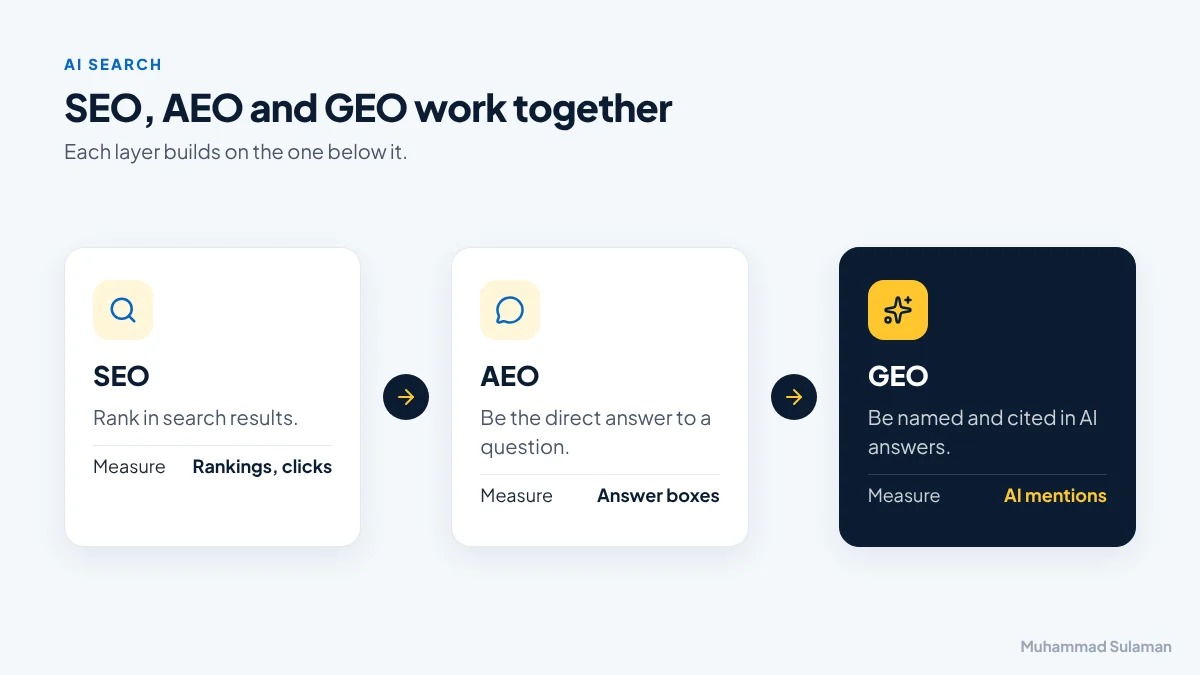
| SEO | AEO | GEO | |
|---|---|---|---|
| Goal | Rank in search results | Be the direct answer | Be named in AI answers |
| Where it shows | Google and Bing results | Featured snippets, voice, AI Overviews | ChatGPT, Gemini, Perplexity, AI Mode |
| What wins | Relevance and authority | Short, clear answers | Trust, facts and brand mentions |
| How to measure | Rankings, clicks | Snippets, answer boxes | Prompt tracking, AI referrals |
How AI tools decide which brands to mention
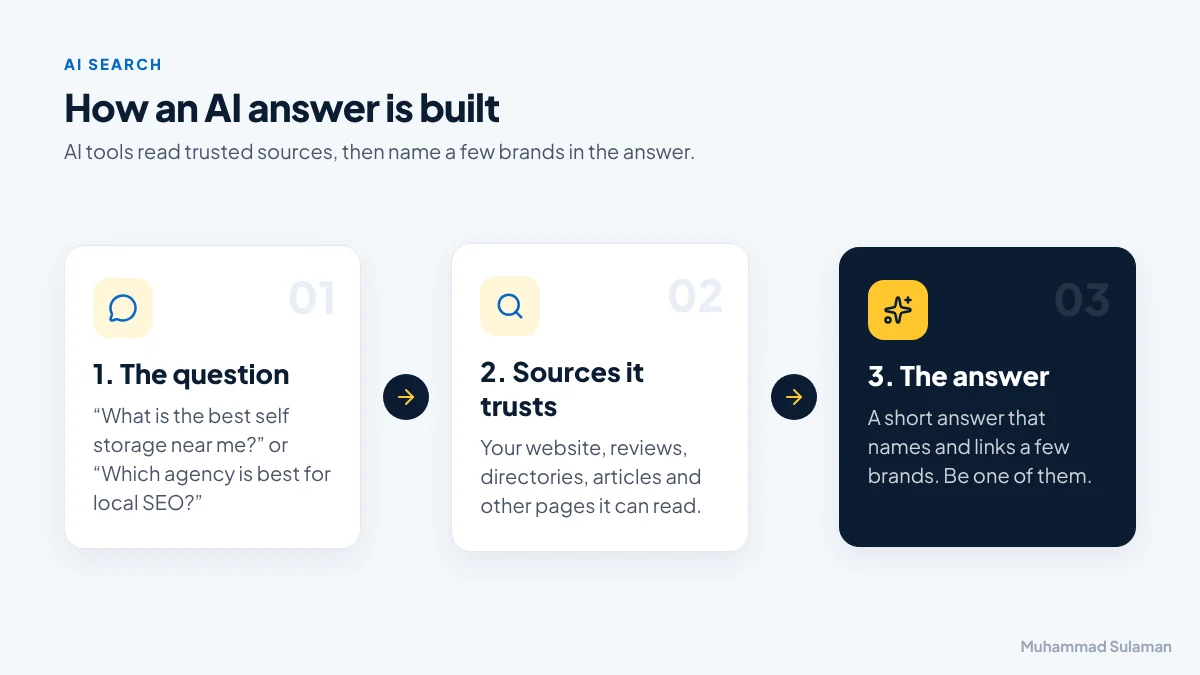
Every AI tool works a little differently, but the pattern is similar. The tool reads the question, looks for sources it trusts, pulls out the useful facts and writes an answer. Brands that appear often, in clear and consistent ways, across trusted sources are far more likely to be named.
That gives you four levers to pull:
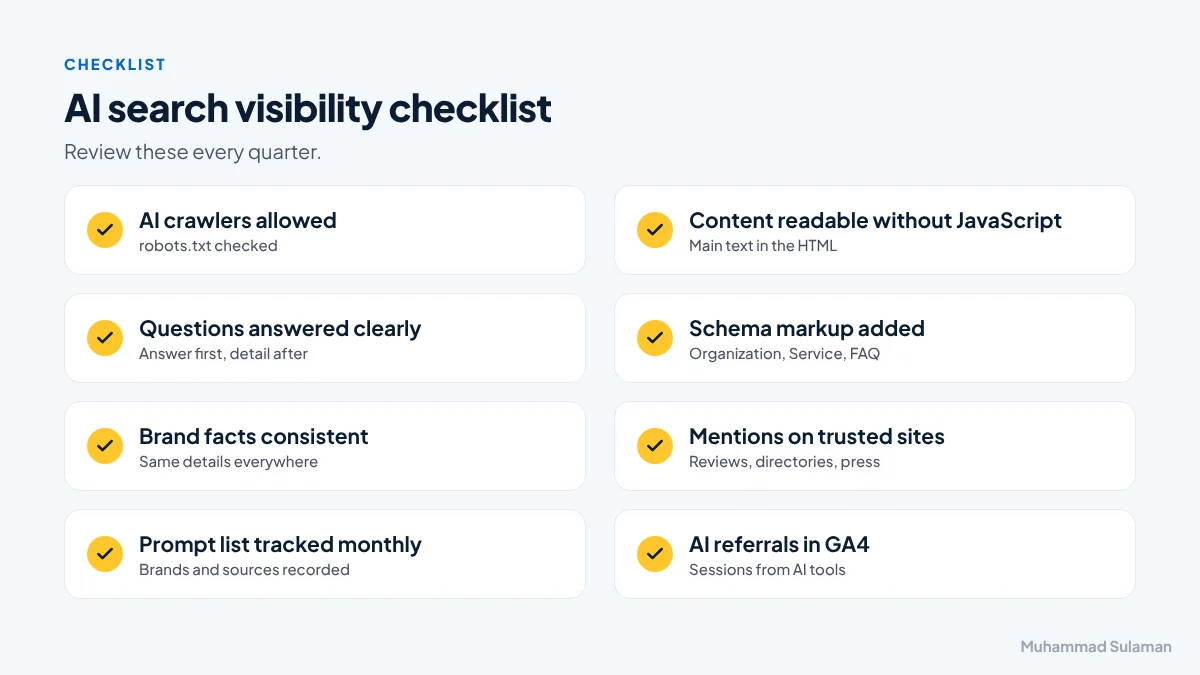
- Be readable. If AI crawlers cannot reach or render your pages, you are out before you start.
- Be quotable. Short, direct answers near the top of the page are easy to lift.
- Be clear about who you are. Consistent brand facts and schema help machines understand you.
- Be mentioned elsewhere. Reviews, directories, press and expert round-ups act as outside proof.
Step 1: Make sure AI crawlers can read your site
Start with the basics, because nothing else matters if your content cannot be read.
- Check robots.txt and make sure you are not blocking the crawlers you want to be found by.
- Make sure your key pages show their main text in the HTML, not only after heavy JavaScript loads.
- Keep important pages indexed in Google, since many AI answers lean on search results.
- Consider adding an llms.txt file that points AI tools to your most useful pages.
Quick test
Open a key page, turn off JavaScript in your browser and reload. If the main content disappears, AI crawlers may struggle with it too.
Step 2: Answer real questions clearly
Write down the 20 to 30 questions your customers ask most. You will find them in sales calls, support emails, Google’s People Also Ask box and Search Console queries. Then answer each one on the most relevant page.
Use this simple pattern for each answer:
- Put the question in a heading.
- Answer it directly in the first one or two sentences.
- Add detail, examples and numbers below.
- Link to the next step, such as a service page or a guide.
Step 3: Add structured data and consistent brand facts
Schema markup tells machines exactly what your page is about. For most service businesses, these types matter most:
- Organization or LocalBusiness for your brand details.
- Service for each service page.
- FAQPage where you answer common questions.
- Article and Person for blog posts and authors.
Just as important, keep your brand facts the same everywhere: name, address, phone, what you do and who you serve. Mixed messages make it harder for AI tools to trust you.
Step 4: Earn mentions on trusted sites
AI tools look beyond your own website. When reputable sites mention your brand in the right context, it strengthens the link between your brand and your topic.
- Get listed on the main directories and review sites in your industry.
- Collect reviews that mention your services and location in the customer’s own words.
- Contribute expert quotes to industry articles and round-ups.
- Publish original data, guides or checklists that others want to cite.
Step 5: Measure your AI visibility every month
You cannot improve what you do not measure. Build a simple tracking routine:
- Write a fixed list of prompts your buyers might use, such as best, near me, versus and how to questions.
- Check each prompt monthly in the main AI tools and record which brands appear.
- Note which sources are cited, so you know where to earn mentions.
- Track AI referral traffic in GA4 by looking at sessions from AI tool domains.
Remember
AI visibility changes as models update. Look at the trend over three to six months, not a single week.
Frequently asked questions
Does AI search replace SEO?
No. AI tools rely heavily on pages that already rank and are trusted. Good SEO is the base that AEO and GEO build on.
How long does it take to see results?
Technical fixes and clearer answers can help within weeks. Brand mentions and authority usually build over a few months.
Can small businesses compete with big brands in AI answers?
Yes, especially for local and niche questions. Clear, specific answers and strong local reviews often beat generic big-brand pages.
Want to know how visible your brand is in AI search?
I will check how often your brand appears in AI answers compared with your competitors, and show you the quickest wins.